Professor Xuejun Li’s Project Receives 2026 Endeavour Fund Extension
An AUT research project developing a fully biodegradable sensor for monitoring seafood freshness has received a 12-month extension through the Ministry of Business, Innovation and Employment’s (MBIE) Endeavour Fund.
Led by Centre’s Core Member, Professor Xuejun (Jack) Li, the project, titled Printable Chipless RFID Tag Sensor on Biodegradable Materials for Seafood Quality Monitoring, was originally awarded NZ$1 million through MBIE’s Smart Ideas programme for the period 2023-2026. The extension will enable the research team to continue developing and validating its innovative approach to real-time seafood freshness monitoring.
The project aims to develop a low-cost and scalable chipless RFID sensor using a fully biodegradable polymer substrate. It combines conjugated polymers and harakeke fibres with a graphene-printed RFID tag, avoiding the conventional silicon microchips used in electronic sensors.
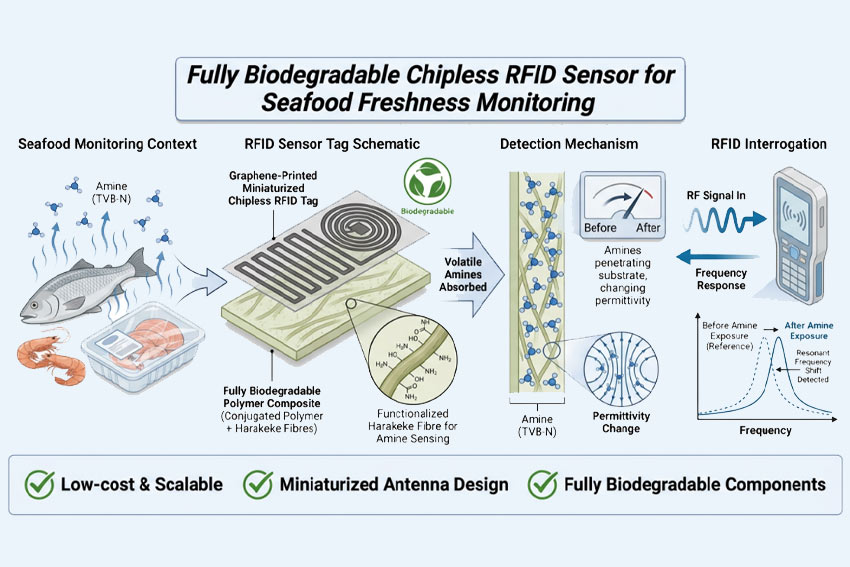
Key innovations include the use of functionalised harakeke fibres for amine sensing, a miniaturised antenna design and fully biodegradable sensor components. The technology could help protect New Zealand’s seafood export industry by enabling real-time, unit-level freshness verification, reducing spoilage during transportation and supporting premium product quality.
The technology could also help seafood packaging meet increasingly stringent international e-waste requirements while creating new commercial opportunities for primary producers and Māori enterprises involved in harakeke cultivation. The extension will enable Professor Li and his research team to continue advancing this sustainable sensing technology towards practical applications in seafood packaging and cold-chain logistics.